Virksomheter bør aktivt søke informasjon om muligheter for økonomisk støtte som kan forbedre deres forskning og utvikling. Å investere i nyskapende løsninger bør alltid vurderes i lys av tilgjengelige fradrag, noe som kan gi langsiktig økonomisk gevinst. Det handler ikke bare om kortsiktige besparelser, men også om å bygge en bærekraftig fremtid.
Gode resultater i forskningen kan lede til ytterligere støtte, og gode relasjoner med både bransjen og akademia kan være avgjørende. Ved å samarbeide med forskningsmiljøer kan man finne nye veier til å utvikle produkter og tjenester som oppfyller markedets behov.
Forståelse av Skattefunn-ordningen i praksis
Det er avgjørende å være klar over hvilke kriterier som må oppfylles ved søknad om støtte til forsknings- og utviklingsprosjekter. Før man starter, bør man sikre at prosjektet har tydelige mål og fokus på nyvinning.
For å lykkes med å navigere i prosessen, anbefales det å dokumentere alle faser av prosjektet. Det kan inkludere detaljer om ideutvikling, testing av konsepter og evaluering av resultater.
- Skape en strukturert tilnærming til alle aspekter av prosjektet.
- Aktivt følge med på utviklingen av krav og retningslinjer.
- Engasjere seg med relevante eksperter eller konsulenter for råd.
Det er også nyttig å se på hvordan tidligere søknader har blitt vurdert. Studier av godkjente prosjekter gir innsikt i hva som er vellykket i denne sammenhengen.
Å søke støtte er ikke bare en formell prosess; det kan også være en kilde til verdifull erfaring som fremmer videre vekst og læring. Ved å fokusere på disse aspektene kan man øke sjansen for å oppnå ønsket resultat.
Kvalifikasjonskrav for å delta i støttesystemer
For å kunne søke støtte, må prosjekter vise til konkrete aspekter av utvikling. Det er avgjørende at selskapet er registrert i Brønnøysundregistrene samt oppfyller krav knyttet til prosjektets omfang og varighet. En god søknad dokumenterer tydelig hvordan prosjektet vil bidra til nyskapning og verdiøkning, samtidig som det kan gi grunnlag for fradrag i skattepliktig inntekt.
Det er også nødvendig at virksomheten faktisk agerer innenfor det aktuelle feltet, med relevant kompetanse og erfaring. Dette vil spille en sentral rolle i evalueringen av søknaden, hvor det vurderes om prosjektet kan få godkjent støtte. Engasjement og kontinuerlig utvikling er derfor essensielt for å oppnå ønskede resultater.
Hvordan navigere i søknadsprosessen for støtte
Forbered deg grundig før du sender inn din søknad. Samle all nødvendig dokumentasjon knyttet til forskning og utvikling, og sørg for at prosjektbeskrivelsen er presis og detaljert. En nøye utarbeidet plan gjør det enklere å overbevise vurderingspanelet om prosjektets kvalitet og potensial. Besøk https://agerasno.com/ for ytterligere ressurser og veiledning.
Hold deg oppdatert på frister og krav knyttet til søknadsprosessen. I tillegg til hoveddokumentene, vil det være nyttig å inkludere en tidslinje og forventede resultater. Struktur og klarhet er avgjørende for å sikre at søknaden blir behandlet raskt og riktig. Snakk med erfarne kolleger eller konsulenter som kan tilby innsikt og råd.
Eksempler på vellykkede prosjekter finansiert gjennom ordninger
Flere prosjekter har oppnådd bemerkelsesverdige resultater ved hjelp av særlige økonomiske tilskudd. Et eksempel er et selskap som utviklet en banebrytende behandling for sjeldne sykdommer. Deres søknad ble godkjent, og dermed fikk de muligheten til å styrke sin forskning.
Et annet vellykket prosjekt involverte et teknologifirma som spesialiserte seg på bærekraftige energiløsninger. Gjennom nødvendig forskning klarte de å redusere produksjonskostnadene med 30% ved hjelp av fradragene de mottok. Dette ga dem muligheten til å utvide markedet.
Innenfor fysisk helse har et flott eksempel vært en utvikling av et treningsprogram ved hjelp av vitenskapelige metoder. Gjennom søknaden fikk de økonomisk støtte som førte til en oppdatert app med nyttige funksjoner, og brukerne opplevde betydelig forbedring i sine resultater.
Et innovativt prosjekt innenfor landbruksteknologi fokuserte på automatisering av gårdsdrift. De søkte om støtte for å gjennomføre forskning på presisjonslandbruk, noe som resulterte i økt avkastning og reduserte ressurser. Resultatene ble formidlet i en vidt anerkjent publisering.
| Prosjekt | Resultater | Støtte |
|---|---|---|
| Behandling av sjeldne sykdommer | Banebrytende metode utviklet | Økonomisk støtte til forskning |
| Bærekraftige energiløsninger | Kostnadsreduksjon med 30% | Fradrag på neste regnskap |
| Treningsprogram | Forbedrede brukerresultater | Støtte til utvikling av app |
| Presisjonslandbruk | Økt avkastning | Forskningstøtte til automatisering |
Å investere i utvikling, spesielt når man søker slike støtteordninger, kan føre til transformative endringer. Selskaper som utnytter disse mulighetene, kan gjøre betydelige fremskritt.
Mange organisasjoner har vist at strategisk bruk av fradrag har en direkte påvirkning på deres muligheter til å vokse. Det er avgjørende å forstå prosessen bak suksessen som kan oppnås gjennom riktig tilnærming.
Spørsmål og svar:
Hva er Skattefunn-ordningen?
Skattefunn er en støtteordning fra den norske staten som gir selskaper økonomisk hjelp til forskning og utvikling (FoU). Gjennom ordningen kan bedrifter få fradrag på skatt for kostnader knyttet til prosjekter som har som mål å utvikle nye produkter, tjenester eller prosesser. Dette innebærer at selskapene kan få opptil 19 prosent av de godkjente kostnadene dekkes gjennom skattefradrag.
Hvem kan søke om Skattefunn-støtte?
Alle norske selskaper, uavhengig av størrelse eller bransje, kan søke om Skattefunn-støtte. Det er imidlertid visse kriterier og krav som må oppfylles. Prosjektene må være knyttet til FoU og ha forskningsinnhold. Det er også viktig at prosjektene bidrar til innovasjon og økonomisk verdiskaping.
Hva er kravene for å få godkjent et FoU-prosjekt?
For at et FoU-prosjekt skal bli godkjent under Skattefunn, må det ha et klart mål om å utvikle noe nytt eller forbedre eksisterende produkter eller prosesser. Det må også inneholde elementer av usikkerhet og risiko, da prosjektet skal være nyskapende. Det er viktig å dokumentere prosjektets fremdrift og kostnader gjennom hele perioden.
Hvordan fungerer søknadsprosessen for Skattefunn?
Søknadsprosessen begynner med at bedriften må registrere seg på Altinn, der de kan fylle ut og sende inn en søknad via en digital plattform. Det kreves at man legger ved relevant informasjon om prosjektet, herunder prosjektbeskrivelse, kostnadsoverslag og tidsplan. Etter innsendelse vil søknaden bli vurdert av Lånekassen, som har ansvaret for administrering av Skattefunn.
Finnes det andre støtteordninger for innovasjon i Norge?
Ja, i tillegg til Skattefunn, finnes det ulike støtteordninger som Innovasjon Norge, som tilbyr tilskudd, lån og rådgivning for innovative prosjekter. Det finnes også regionale ordninger og EU-finansierte programmer hvor norske bedrifter kan delta. Disse ordningene kan gi viktig økonomisk og strategisk støtte for utvikling av nye løsninger og teknologier.
]]>
Google Ads Cost in 2025
In 2025, “Google Ads Revenue” keeps on growing. In 2023, it pulled in $237.855 billion, and approximately $264 billion in 2024. This boost shows just how key the platform is in the online ad world. Businesses need to get how the Google Ads cost work and make sure they’re using their ad money the best way.
Google Ads remains a top advertising platform helping businesses reach their target audiences across the globe. For small businesses and large companies alike, it’s key to understand Google Ads costs, pricing management, and ways to boost return on ad spend (ROAS). Google Ads cost changes fast, and prices shift based on things like competition, industry trends, and how users behave.
This guide will break down Google Ads costs in 2025 looking at main pricing models how to figure out cost-per-click (CPC), and tips to handle your ad budget well.
What Determines Google Ads Pricing?
The cost of Google Ads changes a lot depending on several things. These include how competitive your industry is, what keywords you pick, who you’re trying to reach how good your ads are where you’re targeting, and whether it is a busy season. Getting a handle on these factors helps companies make smart choices, use their ad money, and get better results from their campaigns.
Here’s a small chart summarizing the key factors that affect Google Ads costs:
| Factor | Impact on Google Ads Cost |
| Bidding System | Higher bids set the price, but ad quality can reduce costs even with lower bids. |
| Industry and Competition | Competitive industries like legal or healthcare have higher CPC rates. |
| Geographic Location | Ads in high-demand areas (US, UK, Canada) tend to have higher costs. |
| Seasonal Demand and Time of Year | During peak seasons (e.g., Black Friday), CPC rates can rise significantly. |
| Ad Quality and User Experience | High-quality ads with better user experience result in lower CPC. |
The Bidding System
Google Ads uses a bidding system where companies set the most, they will pay for an ad click. The platform runs an auction, but the highest offer doesn’t always win the top spot. Where your ad ends up depends on a mix of your top bid, quality score, and expected effect of add-ons (like site links or callouts).
Your bid sets the price you’re ready to pay, but ad quality can cut your costs even if you’re not the highest bidder.
Industry and Competition
The competition level in your industry has a huge impact on Google ads costs. Tough sectors like legal, finance insurance, and healthcare see higher CPC rates because many businesses bid on the same keywords. Take the legal industry for instance. It can face CPCs up to $50 per click for hot keywords such as “personal injury lawyer” or “divorce attorney.” In contrast, industries with fewer competitors might enjoy lower CPCs sometimes below $1.
Geographic Location
Where you aim your ads can shape how much you pay for Google Ads. When you target places with lots of buying power, like the US, UK, or Canada, you will often see higher costs per click. This happens because more businesses want to advertise there, so there’s more competition. On the flip side, if you aim at growing markets or countries where people have less money to spend, you might pay less for each click.
Seasonal Demand and Time of Year
At specific times of year, Google Ads costs can jump. Take Black Friday, Cyber Monday, or the holiday season as examples. During these periods more businesses want the same keywords, which drives up CPCs. Companies hoping to cash in on seasonal demand might see their costs soar for sought-after keywords. This is true in retail or online shopping industries.
Ad Quality and User Experience
Google calculates a quality score to evaluate how relevant and effective your ads are. Ads of higher quality (those that match what users are looking for, give a great experience, and take people to pages that fit) cost less than ads that aren’t as relevant or don’t get people to engage. Google gives top-notch ads a lower CPC, but makes low-quality ads more expensive.
How Google Ads Works: CPC and ROAS Explained
Knowing how Google Ads figures out Cost Per Click (CPC) and Return on Ad spend (ROAS) helps you budget your campaigns and check how well they’re doing. CPC is the real amount you shell out when someone clicks your ad. Things like your top bid how good your ad is, and what your rivals are doing can change this. ROAS shows how much money you make for every dollar you put into ads. It’s a big deal because it tells you if your campaign is making a profit. Let’s take a closer look at these two ideas:
What is CPC in Google Ads?
CPC refers to the cost you pay when someone clicks on your advertisement. But your maximum bid doesn’t always match the actual CPC. Google applies an auction model where the highest bidders don’t always get the top spot. , the CPC you end up paying often hinges on the Ad Rank of the advertiser right below you in the rankings.
How Google Ads Calculates ROAS
ROAS = Revenue from Ads / Cost of Ads
ROAS (Return on Ad Spend) shows how well your ad campaigns work. It figures out the money you make for each dollar you put into Google Ads. Let’s say you spend $100 on Google Ads and make $500 in sales. In this case, your ROAS would be 5:1. When you see a higher ROAS, it means your campaign brings in more profit. Google Ads gives businesses tools to keep an eye on this number and make it better, so they get the most bang for their buck.
Strategies to Optimize Google Ads Costs
To get the most out of your Google Ads campaigns, you need to use strategies that have an impact on cost reduction and boost productivity.
Setting Clear Campaign Goals
Before kicking off any Google Ads campaign, you need to know your end goal. Your aim might be to drive more traffic to your website, boost sales, or raise brand awareness. Having clear objectives will help you create effective campaigns. Campaign goals have an impact on your bidding strategy and overall budget, so you need to define them from the beginning.
Smart Bidding Tactics to Cut Google Ads Cost
Google Ads offers various bidding strategies that adjust your bids to achieve the best results at the lowest cost. Includes,
Target CPA (Cost Per Acquisition): This strategy alters bids to help you get as many conversions as possible within your target cost. By setting a desired cost per conversion, this strategy tweaks bids to maximize conversions within your budget making sure you use your advertising money well.
Target ROAS (Return on Ad Spend): This approach aims to boost return on ad spend by changing bids based on expected conversion value. Focusing on increasing revenue compared to ad spend, Target ROAS adjusts bids based on expected conversion values helping to achieve a better return on investment.
Maximize Clicks: This method sets bids to get the most clicks your budget allows. It adjusts bids to bring more visitors to your site while staying within your spending limits.
Maximize Conversions: This approach aims to secure the highest number of conversions for your given budget. By fine-tuning bids to generate as many conversions as possible within your budget, this strategy makes sure your ad money goes toward the most promising opportunities.
Managing Your Budget
A budget with a solid structure plays a crucial role in overseeing your Google Ads expenses. Keep tabs on how your campaigns perform and tweak your budget according to the outcomes. You can also make use of daily limits on spending and smart budget distribution to have a handle on your Google Ads costs.
Google Ads Cost in 2025: Current Trends and Averages
In 2025, Google Ads costs still change based on many things. But some patterns are starting to show up across different fields. Let’s check out the typical CPCs for several big industries in 2025,
| Industry | Average CPC ($) |
| Legal | $6 to $50 |
| Finance & Insurance | $3 to $40 |
| E-commerce | $0.50 to $3 |
| Technology | $1 to $5 |
| Health & Wellness | $2 to $10 |
| Ad Type | Cost Per Click (CPC) | Cost Per 1000 Impressions (CPM) |
| Search Ads | $0.23–$1.72 | $0.57 |
| Display Ads | $0.06 | $0.57 |
| Shopping Ads | Cost-effective, varies | Higher return on ad spend |
How Google Ads Help in the Advancement of Business Goals
Google Ads has an impact on your business by reaching the right people at the right moment. Here’s how Google Ads can helps your company getting,
- Reaching Potential Customers: Companies can zero in on specific user groups by picking relevant keywords.
- Boosting Traffic and Sales: Ads that are well-tuned can lead to more website visits and sales helping your business grow.
- Getting Your Name Out There: Google Ads campaigns are a great way to get noticed and make more people aware of your brand.
Summary
Getting a handle on the costs linked to Google Ads is crucial to manage ad campaigns well. To get the most bang for your buck, companies need to look at key things that have an impact on pricing. These include competition where ads show up how good the ads are, and the ways you bid.
What’s more, you can make sure your Google Ads campaigns work well and don’t break the bank. To do this, use smart bidding methods zero in on keywords that matter, and keep making your campaigns better over time.
If you want to grow your business and boost your ads, Startmetric provides top-notch PPC services to help make your Google Ads campaigns more effective for better CPC, ROAS, and overall outcomes. Check out how our skilled team can help you reach your business targets through custom-made ad plans. Head over to Startmetric’s PPC Services to begin!
]]>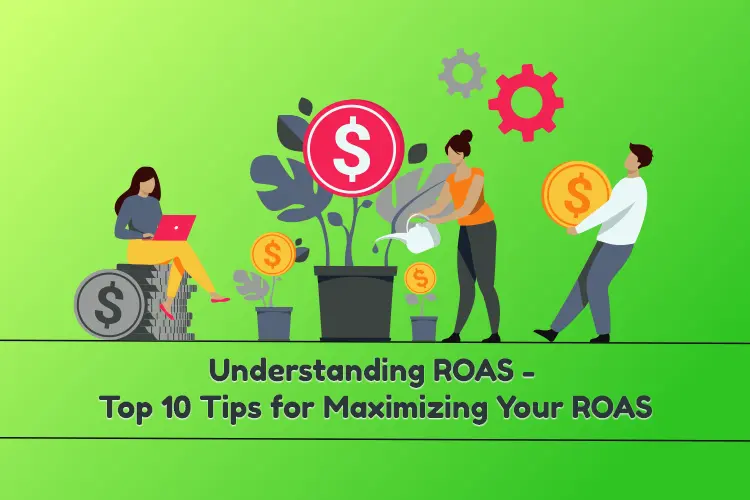
Return on ad spend shows how well your ads work by looking at sales and money from your ad efforts. This post breaks down the return on ad spend process how ROAS differs from ROI, and what return on ad spend numbers mean. We will throw in ten tricks to boost your ad spend returns and pump up your go-to gains.
What is ROAS (Return on Ad spend)?
ROAS stands for Return on Ad Spend. It measures how much you earn for every penny spent on advertising. For example, if you spend a hundred on advertising and make three hundred on sales, your return on ad spend is 3:1. This means he got three times the amount he spent. ROAS helps you measure the effectiveness of your ads.
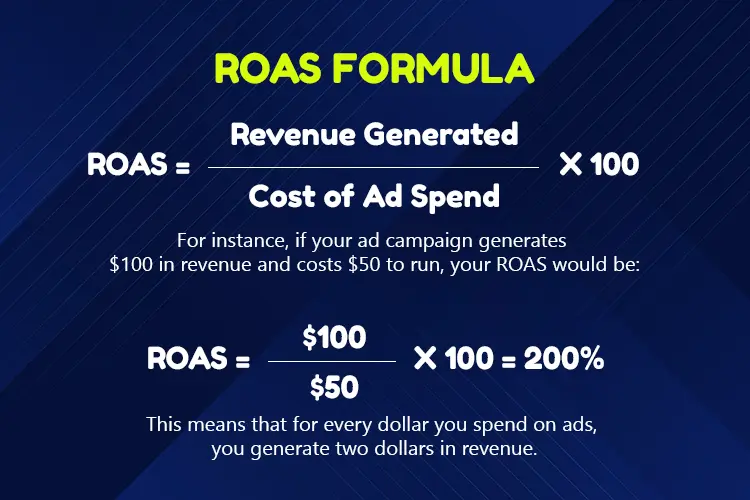
ROAS Formula
The ROAS formula is straightforward
ROAS = (Revenue Generated / Cost of Ad Spend) x 100
For instance, if your ad campaign generates $100 in revenue and costs $50 to run, your ROAS would be:
ROAS = ($100 / $50) x 100 = 200%
This means that for every dollar you spend on ads, you generate two dollars in revenue.
How to Determine ROAS
Use this simple way to do it
Track Ad Spend
Keep a record of every dollar you spend on advertising campaigns. This includes:
- The cost of the ads.
- The cost of placing the ads.
- The cost of making/designing the ads.
- Any other expenses related to running the ads.
Track Revenue
Keep track of the money made from each advertising campaign. This includes:
- Sales revenue.
- Conversions from the ads, like leads.
Find ROAS
- Use this formula: Return on ad spend = (Revenue Earned / Cost of Ad Spend) x 100%.
- For example, if an ad cost 50 and brought in 100, the calculation would be:
- ROAS = (100 / 50) x 100% = 200%.
- This means you made two dollars in revenue for every dollar you spent.
By following these steps, you can easily determine the Return on ad spend for your ad campaigns and see how well they perform. You can instantly see the return on investment in any advertising campaign and measure its effectiveness by following these simple steps.
ROAS and ROI
While both ROI and ROAS are important, they serve different purposes. Marketing ROI calculates the return on investment in a project or activity, while return on ad spend examines the revenue generated by a specific advertising campaign or strategy
ROI provides a comprehensive view of the overall performance of a business or project. In contrast, Return on ad spend helps to optimize advertising spend and increases the effectiveness of advertising efforts.
What is Good ROAS?
Good Return on ad spend depends on your business, audience and advertising spend. Here are some general guidelines
- Optimal ROAS for eCommerce businesses is often over 150%.
- Good Return on ad spend for B2B businesses will be 200% higher.
- Good ROAS for service-based businesses typically exceeds 300%.
10 Tips for Maximizing Your ROAS
ROAS is key to measuring the effectiveness of an PPC or advertising campaign and optimizing your ad spend. Setting clear objectives, targeting high-value audiences, and using user-generated content can increase your return on advertisement spend and to grow your business.
1. Set clear goals
Define your ROAS goal before launching an advertising campaign. This helps you focus and measure your success. Consider your revenue goals, audience, and duration of advertising.
2. Optimize your ad spend
Review and adjust your ad budget on a regular basis. Use tools like Facebook Ads Manager to monitor performance. Assign more budgets to underperforming ads and reduce spending on underperforming ads.
3. Target the Most Valuable Audience
Use statistics to find and target the audience with the highest conversion rates. This includes frequent buyers or bulk orders. Tools like Google Analytics and Facebook Insights can help identify these categories.
4. Use Retargeting Ads
Retarget those who interacted with your business but didn’t make a purchase. These ads remind potential customers of their findings, increasing their chances of conversion.
5. Leverage the brand
Encourage customers to do things that are relevant to your brand. Content feels more authentic to the user and can increase engagement and conversion. Share this information on social media and in your marketing campaigns.
6. Use A/B Testing
Test ad formats, headlines, and call-to-actions to see what works best. A/B testing helps you find the most effective content and improves your Return on ad spend.
7. Monitor and adjust
Monitor your Return on ad spend and other key performance indicators (KPIs). Use the data to tailor your campaigns. Change ads that don’t work well or change them quickly.
8. Use the same audience
Reach out to new customers who are like your ideal customers. Platforms like Facebook and Google can build similar audiences based on the customers’ high-value information.
9. Use Dynamic Ad Creative
Customize ads to everyone’s tasks and preferences. This personalization can increase engagement and conversion. Facebook Dynamic Ads are useful for this.
10. Use ROAS-Optimized bidding
Use bidding strategies from advertising platforms. These algorithms adjust your bids to maximize return on ad spend, and ensure you get the best return on your ad spend. Tools like Google Ads, Target ROAS bidding can help.
Continue to measure and optimize your strategies to improve efficiency, and experiment with new ways to increase your return on ad spend. With the right approach, you can improve your ROAS and achieve your business goals.
Final Thoughts
Return on ad spend is important for any organization that invests in sponsored advertising. By understanding the return on ad spend process, the difference between ROAS and ROI, and knowing what makes Return on ad spend successful, you can fine-tune your ad spend to get results. Startmetric Services offers PPC services that can further optimize your campaigns. To increase your return and reach your business goals, set clear goals, optimize your ad spend, target maximum customer value, and deliver user-generated content. Keep experimenting and adapting, and you will unlock the potential for extraordinary business improvement.
]]>
Pay-per-click (PPC) advertising has become a cornerstone of modern marketing campaigns. With the rise of search engines and social media, businesses now have an unprecedented ability to target specific audiences with precision and efficiency. But navigating the world of PPC services can be daunting, especially for those new to the game. In this article, we’ll provide a comprehensive guide to PPC services, covering everything from keyword research to campaign optimization.
Introduction
Businesses in today’s digital age are always looking for methods to improve their online presence and attract visitors to their websites. Pay-per-click (PPC) advertising is an efficient way to achieve these objectives. PPC advertising allows businesses to display their adverts in front of a highly focused audience, increasing traffic, sales, and income. In this post, we’ll look at PPC services and how they may help you run effective campaigns.
What Exactly are PPC Services?
PPC marketing services specialize in the development, management, and optimization of pay-per-click advertising programs. These services may be provided by marketing firms, freelancers, search engines, or the social media networks themselves. PPC services may vary widely in their offerings, however, most will include some combination of the following:
• Keyword investigation
• Ad development and optimization
• Budgeting and bidding techniques for campaigns
• Campaign tracking and analysis
Fees for PPC services typically range from a percentage of ad expenditure to a flat payment for each campaign.
Benefits of PPC Services
PPC services provide several advantages for organizations seeking to generate traffic to their website and enhance revenue. Some of the primary advantages of PPC services are as follows:
- Increased visibility: PPC advertisements may help businesses reach their target demographic with pinpoint accuracy, enhancing brand exposure and visibility.
- Cost-effectiveness: Businesses only pay for PPC advertising when someone clicks on their ad, making it a cost-effective approach to generate traffic to their website.
- Immediate results: PPC campaigns may begin generating visitors to a website soon after launch, enabling businesses wishing to improve their online presence with instant results.
- Highly targeted: Businesses may use PPC advertising to target certain demographics, areas, and keywords, ensuring that their ads are seen by the correct people.
- Measurable: PPC campaigns give specific performance information to organizations, allowing them to analyze campaign success and make data-driven choices.
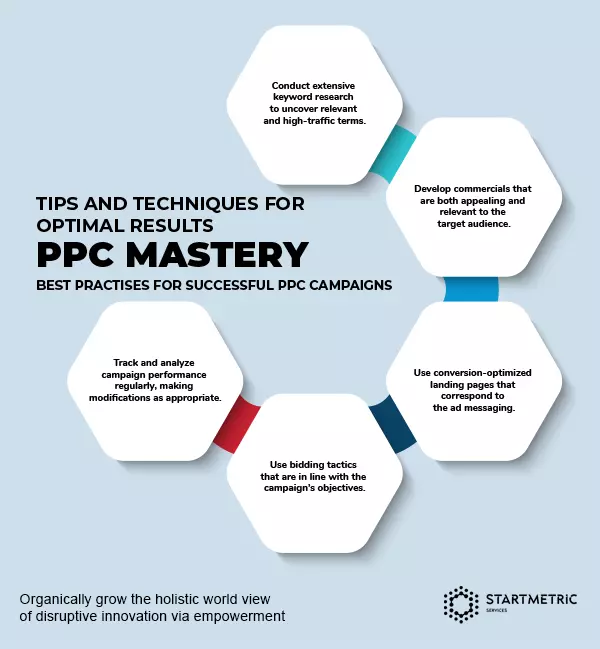
Best Practices for Successful PPC Campaigns
When creating and managing a PPC campaign, there are several best practices to follow:
• Conduct extensive keyword research to uncover relevant and high-traffic terms.
• Develop commercials that are both appealing and relevant to the target audience.
• Use conversion-optimized landing pages that correspond to the ad messaging.
• Use bidding tactics that are in line with the campaign’s objectives.
• Track and analyze campaign performance regularly, making modifications as appropriate.
Keyword Research
Keyword research is performed to determine which terms and phrases potential customers are likely to search for. Among the keyword research tools accessible are Google Keyword Planner, SEMrush, and Ahrefs.
It is vital to examine each keyword’s relevancy, search volume, and level of competition when conducting keyword research. A term’s relevance refers to how closely it is related to the product or service being provided. The search volume of a phrase refers to how frequently it is searched. The level of competition is proportional to the number of other marketers targeting the same term.
Ad Creation and Optimization
The process of planning and generating the actual advertising that will be presented to potential clients is known as ad creation. Search advertisements are the most prevalent sort of PPC ad used in PPC campaigns and are displayed on search engine results pages (SERPs) when consumers search for specified keywords or phrases. Display advertisements are a sort of PPC ad that appears on websites that have chosen to participate in the ad network of the search engine or social media platform being utilized.
Once the ads have been created, they must be optimized for maximum effectiveness. Ad optimization involves testing and tweaking various elements of the ad, including headlines, ad copy, and call-to-action buttons, to improve click-through rates and conversions.
Landing Page Optimization
A landing page is the web page to which a user is routed after clicking on a PPC advertisement. Landing pages are critical to the success of a PPC campaign, and they should be built with a clear and straightforward message that corresponds to the ad with which they are related.
Landing pages should be optimized to increase conversions, which may be accomplished by A/B testing, page load speed optimization, and the use of clear and enticing headlines and calls to action.
Budgeting and Bidding Strategies for Campaigns
Budgeting and bidding strategies are essential components of PPC campaigns. A budget ensures that the campaign stays within its budget, whereas bidding strategies determine how much to bid for each click.
Bidding strategies may fluctuate depending on the platform and the goals of the campaign. Bidding strategies that are commonly used include manual bidding, automated bidding, and enhanced cost-per-click (ECPC) bidding.
Campaign Tracking and Analysis
The ability to track and analyze the effectiveness of a PPC campaign is vital to its success. Google Analytics and third-party analytics tools are among the tools available for tracking and analyzing PPC campaigns.
Click-through rates (CTR), conversion rates, and return on ad spend (ROAS) should all be tracked and analyzed regularly to find areas for improvement and optimize campaign success.
Common PPC Campaign Mistakes to Avoid
There are some typical pitfalls to avoid when developing and managing a PPC campaign:
• Failing to conduct thorough keyword research.
• Failure to optimize landing pages for conversions.
• A focus on click-through rates rather than conversions.
• Failing to track and analyze marketing results.
• Failure to adapt bid strategy in reaction to performance indicators.
Conclusion
For companies trying to boost their online presence and generate visitors to their websites, PPC advertising may be a strong strategy. Businesses may design effective PPC campaigns that deliver results by following best practices for keyword research, ad creation and optimization, landing page optimization, budgeting and bidding strategies, and campaign tracking and analysis.
]]>
Introduction
Are you looking for a cost-effective to promote your business in front of your niche audience? If so, look no further beyond Pay-Per-Click (PPC) advertising. PPC advertising is one of the best and most efficient marketing strategies that would help your website gain niche traffic that would improve your leads or sales. With PPC advertising, businesses can get instant traffic to their website. They do not have to wait for organic traffic to come in. In this blog post, let us understand what PPC is. Also, let us look at the top reasons why PPC is so important, especially for small businesses.
What Exactly is PPC Advertising?
PPC, or pay-per-click, is one of the most promising marketing strategies in which advertisers pay a certain pre-defined amount each time their ads get clicks from online users. To explain this, you can consider PPC as a form of advertising where you would pay a certain amount to get visitors to your website rather than directing them organically. The traffic your website receives from this approach would undoubtedly have an interest in your offering, resulting in improved leads or sales. Eventually, you would gain a higher ROI.
Different Types of PPC Advertising
PPC ads can get categorized into Text Ads, Display Ads, and Video Ads. Each type of PPC advertising benefits businesses in multiple ways. So it is crucial to decide which type of advertising would fuel your business growth.
-
Text Advertising
Text ads are one of the most extensively used formats of PPC ads. They are typically short and to the point. This type of advertising is best for businesses looking to drive niche traffic to their website from multiple search engines like Google, Bing, etc.
-
Displaying Advertising
Display ads are also one of the most popular approaches to pay-per-click advertising. These ads are usually more visually appealing than text ads, and they are the perfect strategy to gain brand recognition and drive niche traffic to your website. This form of advertising is the best approach to improve leads or sales through remarketing.
-
Video Advertising
Video ads are a less common type of PPC ad, but they can be very effective. Advertising through creating videos is a positive approach to grabbing user attention and driving traffic to your website.
Popular PPC Advertising Platforms
Search Engine platforms are not just one of the most common but are also one of the most profiting platforms for PPC advertising. In this approach, advertisers need to bid a certain amount on keywords that are relevant to their businesses and have a high search volume. When a user enters a particular keyword in a search engine, your ad could appear at the top of search results. Whenever a new user clicks on your ad, you will be charged a specified amount (the “bid”) for the click.
Facebook is one of the most popular platforms for Pay-Per-Click advertising. Facebook ads are the best-easy-to-target audiences based on interests, demographics, and behaviors.
What Makes PPC Advertising Crucial for Small Businesses?
If you are a small business owner, you must have already known that every penny counts and that you need to make the most of your marketing budget. It is where pay-per-click (PPC) advertising becomes crucial. Small businesses can benefit from PPC campaigns in many ways
- PPC campaigns allow you to bid on keywords that potential customers search. When your ad gets a click from a user, they get directed to your website. From there, they will get more information about our products or services.
- In PPC campaigns, you pay when your ad gets a click from a user. Here, you would be spending your valuable budget on showing your ads only to those specific people who are interested in the services or products that you offer.
- Another benefit of PPC campaigns is that they get targeted to a specific geographic area. It is perfect for small businesses that only serve a particular region.
- Finally, PPC campaigns can get customized to match the different stages of the buyer’s journey. It means that you can create ads that target people who are just starting their research to those who are ready to make a purchase.
So, undoubtedly PPC campaigns are the best approach to market a small business. It is the best affordable & most effective way to reach a niche audience and grow your business beyond leaps and bounds.
Top Reasons Why Small Businesses Should Consider PPC Advertising
-
PPC Ads Reach Audiences Cost-Effectively
PPC advertising is one of the best marketing approaches to promote your business to users that are actively searching for the services that you are offering. When someone searches on Google, they are generally looking for something specific. If you can create highly engaging ads by targeting unique selling points, there is a good chance that users will notice and click on them. It is also the most economical marketing approach to reach your niche audience. You get charged when your ad receives a click. So the complete budgeting will be in your control.
Also, PPC advertising lets you target your niche users with high precision. You can use PPC to target people based on their geographic location, demographics, interests, and even past behavior.
-
Ads Provide Instant Traffic
PPC advertising is one of the intelligent ways to get instant traffic to your website. It allows advertisers to select their targeted audience very specifically. PPC makes it possible to get instant traffic to your website without having to wait for organic traffic to come in. You will have complete control right from the keywords selection to the audience you wish to target, and you can also target specific locations. With PPC advertising, you will have complete control over your ad visibility. Your ad gets shown to users who need services similar to what your business offers.
-
Ads Drive Warm Leads
PPC ads are the perfect way to drive warm leads because they allow you to promote your ads to niche users with higher accuracy. You have complete control from choosing to whom your ad must get shown to selecting the location where the ad should be visible to users with specific interests. So, your ad would get seen by the particular group of people who are more likely interested in your business.
-
Ads Lead to Positive ROI
PPC ads are the best way to improve your ROI because they allow you to target your audience effectively. You can choose what keywords to target, what time of day to show your ad, and where to display your ad. By targeting the audience to the exact location, your ads are more likely to get clicks, and if everything turns positive, there is a high chance for conversion. Also, as per the stats, the conversion rate of PPC is much higher than other types of advertising. It is because people who click on your ad are more likely to be interested in what you have to offer.
So, if you are one of those business owners looking to gain maximum ROI on their ad budget, consider using PPC ads.
-
Ads Allow For Smart Retargeting
Smart retargeting is an advanced marketing approach where you advertise your business in front of users who have previously shown interest in your business offerings. As users browse the web, your ad gets displayed to remind them of your product or service and bring them back to your site to convert. Smart retargeting is the best approach to increase your conversion rate and keep your existing customers connected with your business.
Retargeting is the ideal solution for small businesses to boost their conversion rate and scale their business.
-
User Data Helps Your SEO Strategy
When you run a PPC campaign, you generate a lot of data about your target audience. And this data can be valuable in shaping your SEO strategy.
For example, if you are about to run an ad campaign to promote your online course, you will search for keywords related to your service. You will also want to target specific keywords searched by users in addition to your main search terms. To do this, you can use PPC data to help you understand which keywords are most likely to convert into sales.
The Data collected from PPC ads is also analyzed. It gives a detailed view of expensive and high-competition keywords. This information can be valuable in shaping your SEO strategy.
-
Ads Do Not Depend on Algorithm Changes
PPC ads are the best marketing solution for businesses to promote their message in front of niche customers. Here, they do not need to worry about algorithm changes as PPC ads do not get displayed on websites through an automated process. The entire process here relies on the biding amount you are willing to pay per click.
If a business is willing to pay more per click than its competitors, its ad will appear higher on the SERP. However, if a company is not ready to bid as much per click, its ad will appear lower on the SERP.
-
Boosts Your Company Brand
As a business owner, you must understand the prominence of having a good brand. You know that a strong brand can help you attract new customers, retain existing customers, and earn more profits.
PPC ads are undoubtedly the best approach to building value for your brand. It allows you to target your ads to niche users looking for services similar to yours. For example, if you sell products or services to businesses, you can use PPC to target your ads to business owners.
-
Has Measurable Results
Any business can achieve success only when the progress is tracked from time to time with necessary improvements wherever required. The same goes for marketing efforts. One of the best aspects of PPC advertising is that results get tracked. We can analyze the metrics to see how your ads are running. The analyzed data can help you adjust your campaigns to improve your results.
-
Lets You Target Local Or Global Markets
PPC makes it possible to promote your business across local or global markets with laser precision. So, if you are a small business looking to expand, PPC advertising can help you broaden your reach. You can also target your ideal customers, no matter where they exist in the world.
Conclusion
PPC advertising is one of the best marketing solutions that help both small and large businesses reach their niche audience and generate leads or sales. However, if you are running a small business, it is crucial to remember that you are essentially paying for each click. So, a lot of effort is needed to create ads that are well-targeted and relevant to your products or services. Otherwise, you would waste a lot of your marketing budget on clicks that do not convert. If you are thinking of using PPC to drive traffic to your site, StartMetric Services can help. Our team of experts can create a custom PPC campaign that fits your budget and goals. Contact us today to learn more.
]]>